
Alpha‑1
Alpha‑1 begins in the liver, progresses silently in the lungs, and hides in plain sight. We need to act now.



What is Alpha‑1?
Alpha‑1 Antitrypsin Deficiency (Alpha‑1) is a progressive, genetic condition that can silently and irreversibly damage the liver and lungs. It is also known as AAT, AATD, genetic COPD/emphysema, and genetic cirrhosis. The impact of Alpha‑1 in the United States is formidable. In fact, a genetic, epidemiologic meta-analysis estimated that approximately 20 million people in the U.S. carry one or more deficient AAT alleles., In addition, approximately 100,000 people have two deficient alleles, which is the definition of Alpha‑1. However, nine out of ten of those with Alpha‑1 have not been diagnosed.
Healthcare providers can play a critical role in detecting individuals with Alpha‑1 in their practices. Identification of Alpha‑1 changes how liver and lung disease is managed: treatment options and specific care plans are available.
Who to test?
Many clinical practice guidelines, standards, and expert consensus statements recommend testing for Alpha‑1 in patients with liver and/or lung disease,,,







To ensure that no affected individual goes undetected, test your patients with:
- COPD, regardless of age or ethnicity
- Emphysema
- Asthma, if there is persistent obstruction despite optimized treatment
- Bronchiectasis, if otherwise unexplained
- Liver disease
- Panniculitis and anti-proteinase-3
- Parents, siblings, and children of individuals identified with deficiency of alpha-1 antitrypsin should be tested
Early detection can help guide appropriate management and prevent irreversible damage due to progressive liver and/or lung disease.
Recommendations above are from the American Thoracic Society (ATS), European Respiratory Society (ERS), the American College of Chest Physicians (CHEST), Global Initiative for Chronic Obstructive Lung Disease (GOLD), the American Gastroenterological Association (AGA), the American Association for the Study of Liver Diseases (AASLD), and the European Association for the Study of the Liver (EASL). They are representative, but not fully inclusive of all reference sources.
The 101 on Alpha‑1

What Causes Alpha‑1?
Alpha‑1 is caused by genetic mutations, or deficient alleles, in the SERPINA1 gene. This gene provides instructions for making a protein called alpha‑1 antitrypsin (AAT)—a protective protein produced in the liver.

What is the Risk to the Liver?
Abnormal AAT protein accumulates within hepatic cells, leading to cellular stress, inflammation, and progressive, irreversible damage.
Over time, this toxic buildup can result in scarring, fibrosis, cirrhosis, and, in severe cases, liver failure or hepatocellular carcinoma.
What is the Risk to the Lungs?
Insufficient AAT levels leave lung tissue vulnerable to the enzyme neutrophil elastase, which attacks and destroys normal lung tissue.
Over time, this unchecked activity can lead to alveolar destruction, chronic inflammation, and the development of conditions like COPD, emphysema, and bronchiectasis, even in individuals who have never smoked.

What Role Does Genetics Play?
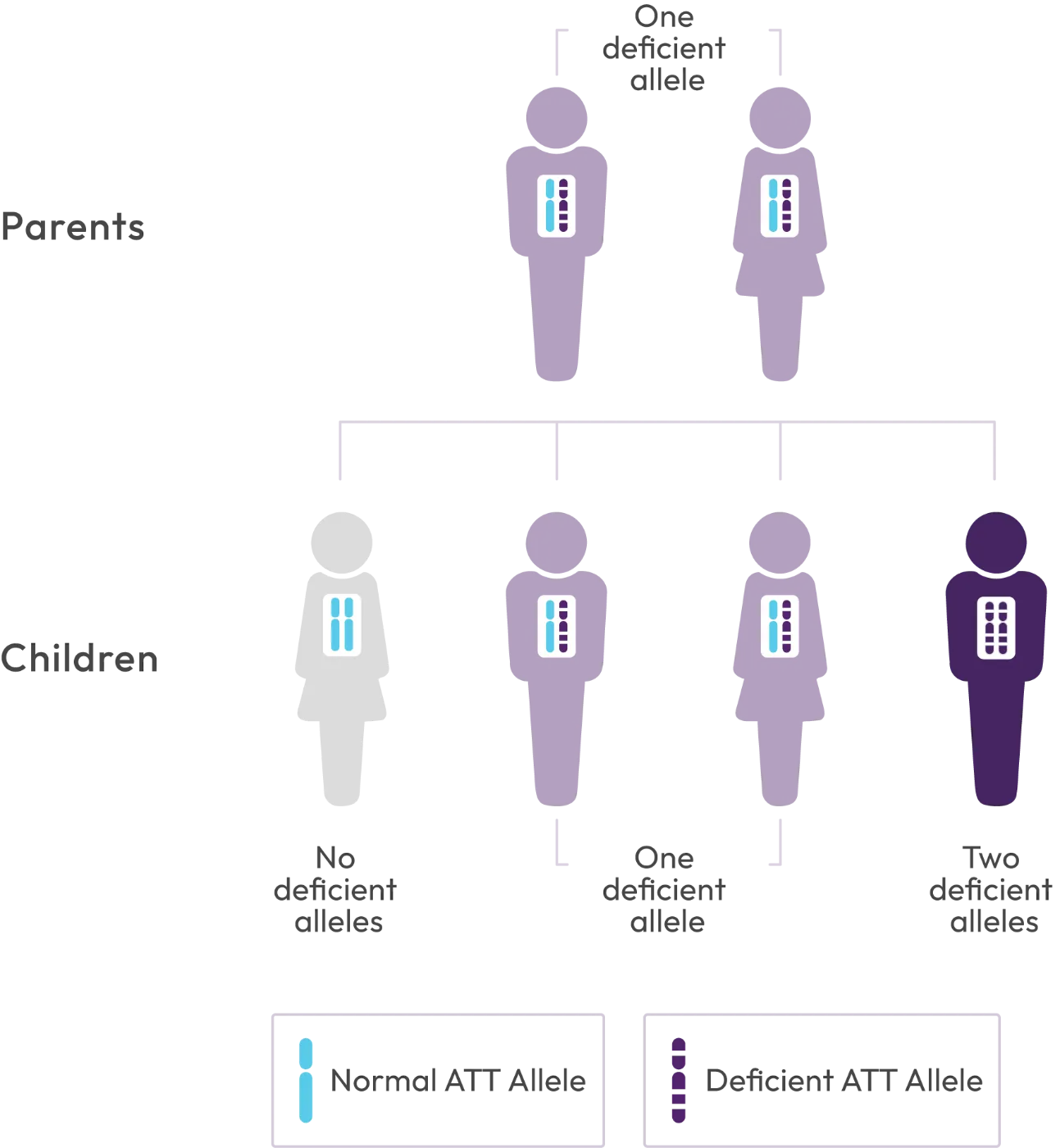
Alpha‑1 is a genetic condition. Affected individuals inherit one allele from each parent. Together, these two alleles determine an individual’s genotype. Importantly, even among those with the same genotype, clinical presentations and disease burdens can vary significantly.

How Many Are Affected?
Approximately 20 million people in the U.S. carry at least one deficient allele., Typically, those with one deficient allele—also known as carriers—don’t develop severe symptoms but can pass the deficient allele to their children.

How Many Have Alpha‑1?
Approximately 100,000 people in the U.S. have two deficient alleles, which is the definition of Alpha‑1. Yet 9 out of 10 remain undiagnosed. That’s why it’s important to know if there is an underlying, genetic cause in patients with liver and/or lung disease.
What causes Alpha‑1?
Alpha‑1 is caused by genetic mutations, or deficient alleles, in the SERPINA1 gene. This gene provides instructions for making a protein called alpha‑1 antitrypsin (AAT)—a protective protein produced in the liver.

When AAT functions normally, it helps protect the lungs from inflammation and tissue damage. But in people with Alpha‑1:
- Abnormally misfolded AAT protein can become trapped in the liver, where it may accumulate and cause progressive and irreversible liver damage
- In some patients, insufficient levels of AAT reach the lungs, leaving them vulnerable to irreversible damage over time
Because Alpha‑1 symptoms often resemble those of more common liver diseases, eg, cirrhosis, and lung diseases, eg, COPD and emphysema, the condition can remain hidden in plain sight until genetic testing is performed.
What Role Does Genetics Play?
Alpha‑1 is a genetic condition. Affected individuals inherit one allele from each parent. Together, these two alleles determine an individual’s genotype. Importantly, even among those with the same genotype, clinical presentations and disease burdens can vary significantly.
Identifying a deficient allele indicates an increased risk among biological relatives and should prompt discussion of family testing. The family tree at rightbelow shows how the risk for Alpha‑1 is inherited.
In accordance with clinical guidelines, testing family members of an individual with one or more deficient alleles, ie, parents, children, and siblings, can uncover others who may be at risk. Learning that they have one or two deficient alleles—even if they are asymptomatic—gives individuals the opportunity to make more informed lifestyle decisions, such as avoiding smoking and limiting environmental irritants that can meaningfully impact disease outcomes.
How Alpha‑1 Can Be Passed Down to Future Generations
More than 150 different SERPINA1 gene alleles have been identified. The most common are below:
Common Normal Allele
| M allele | Normal, functional AAT production |
|---|
Common Deficient Alleles
| Z allele | Causes AAT to accumulate in the liver, resulting in severely deficient circulating AAT and liver disease. |
|---|---|
| S allele | Moderately deficient AAT production |
| F allele | Normal production and levels, but the protein does not function. |
| I allele | Moderately deficient AAT production |
How Many Are Affected?
Approximately 20 million people in the U.S. carry at least one deficient allele., Typically, those with one deficient allele—also known as carriers—don’t develop severe symptoms but can pass the deficient allele to their children.
Millions Are Affected But May Not Know It.
Approximately 20 million have one or more deficient alpha‑1 alleles
 One or more deficient alpha‑1 alleles
 Two deficient alpha‑1 alleles

100,000 have two deficient alpha‑1 alleles
How many have Alpha‑1?
Approximately 100,000 people in the U.S. have two deficient alleles, which is the definition of Alpha‑1. Yet 9 out of 10 remain undiagnosed. That’s why it’s important to know if there is an underlying, genetic cause in patients with liver and/or lung disease.

Hidden in Plain Sight: 9 out of 10 People With Alpha‑1 Have Not Been Diagnosed
With so many individuals still undiagnosed, could there be a few in your practice? The only way to know for sure is by routinely testing patients with liver and/or lung disease for Alpha‑1, in alignment with clinical practice guidelines.
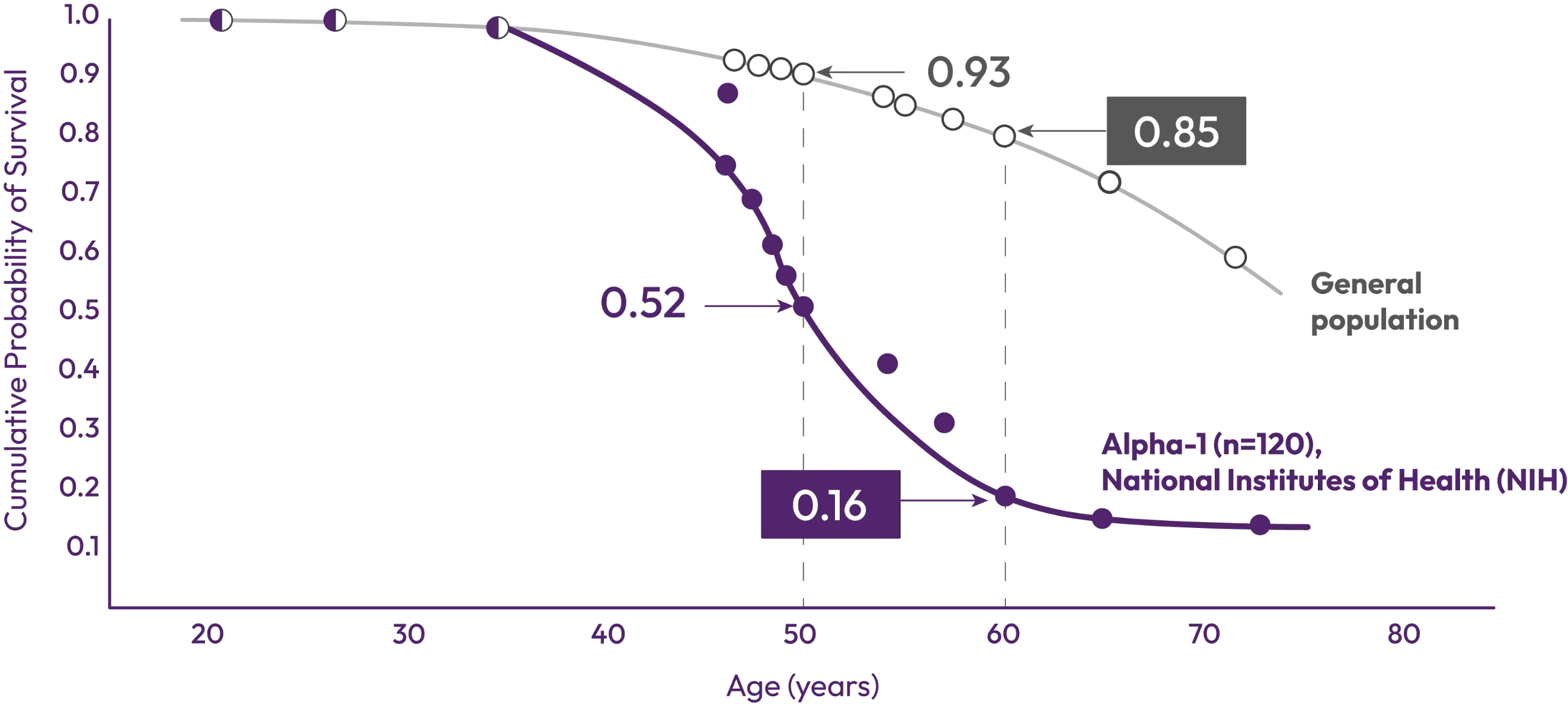
Survival data
Survival data from a landmark study published in the American Review of Respiratory Disease. Timely detection can accelerate answers to inform decisions.
Survival Analysis of Alpha‑1 Cohort vs General Population (US)
I wasn't diagnosed with Alpha‑1 until I lost over 70% of my lung function. No one should wait that long for answers.

By prioritizing earlier detection, healthcare providers can identify people who are unaware that they are living with Alpha‑1—and at-risk family members—thereby accelerating answers and informing decisions. AlphaDetect can be your partner in integrating routine, guideline-aligned testing into your clinical workflow.

References: de Serres FJ. Worldwide racial and ethnic distribution of alpha1-antitrypsin deficiency: summary of an analysis of published genetic epidemiologic surveys. Chest. 2002 Nov;122(5):1818-29. doi:10.1378/chest.122.5.1818. PMID: 12426287. Nelson DR, Teckman J, Di Bisceglie AM, Brenner DA. Diagnosis and management of patients with α1-antitrypsin (A1AT) deficiency. Clin Gastroenterol Hepatol. 2012 Jun;10(6):575-80. doi:10.1016/j.cgh.2011.12.028. Epub 2011 Dec 23. PMID: 22200689; PMCID: PMC3360829. Stoller JK. Alpha‑1 antitrypsin deficiency: A persistently underrecognized condition. Cleve Clin J Med. 2026 Mar 2;93(3):153-157. doi:10.3949/ccjm.93a.25103. PMID: 41771676. Brantly M, Campos M, Davis AM, et al. Detection of alpha-1 antitrypsin deficiency: The past, present and future. Orphanet J Rare Dis. 2020;15(1):96. doi:10.1186/s13023-020-01352-5. American Thoracic Society; European Respiratory Society. American Thoracic Society/European Respiratory Society statement: standards for the diagnosis and management of individuals with alpha-1 antitrypsin deficiency. Am J Respir Crit Care Med. 2003 Oct 1;168(7):818-900. doi:10.1164/rccm.168.7.818. PMID: 14522813. Sandhaus RA, Turino G, Brantly ML, et al. The Diagnosis and Management of Alpha-1 Antitrypsin Deficiency in the Adult. Chronic Obstr Pulm Dis. 2016 Jun 6;3(3):668-682. doi:10.15326/jcopdf.3.3.2015.0182. Global Initiative for Chronic Obstructive Lung Disease (GOLD). Global Strategy for Prevention, Diagnosis and Management of COPD: 2026 Report. Fontana, WI: Global Initiative for Chronic Obstructive Lung Disease; 2026. https://goldcopd.org/wp-content/uploads/2026/01/GOLD-REPORT-2026-v1.3-8Dec2025_WMV2.pdf Accessed September 4, 2026. Loomba R, Clark VC, Mandorfer M, Miravitlles M, Brantly M, Karpen SJ, Krag A, Kwo PY, Rockey DC, Russo MW, Sanchez AJ, Santarella S, Sharpton SR, Strange C, Teckman JH, Turner AM, Vargas HE, Strnad P. Multi-Society Expert Panel Consensus Guidance Regarding Clinical Assessment and Clinical Trial Endpoints in Adults With Alpha‑1 Antitrypsin Deficiency-Associated Liver Disease. Gastroenterology. 2026 Apr;170(4):829-842. doi:10.1053/j.gastro.2025.12.012. Epub 2025 Dec 11. PMID: 41390004. Molloy K, Hersh CP, Morris VB, et al. Clarification of the risk of chronic obstructive pulmonary disease in α1-antitrypsin deficiency PiMZ heterozygotes. Am J Respir Crit Care Med. 2014 Feb 15;189(4):419-27. doi:10.1164/rccm.201311-1984OC. PMID: 24428606; PMCID: PMC5955067. Brantly ML, Paul LD, Miller BH, et al. Clinical features and history of the destructive lung disease associated with alpha-1-antitrypsin deficiency of adults with pulmonary symptoms. Am Rev Respir Dis. 1988;138(2):327-336.