


Alpha‑1 Cheek Swab Collection Kit and Test Report
The Cheek Swab Collection Kit
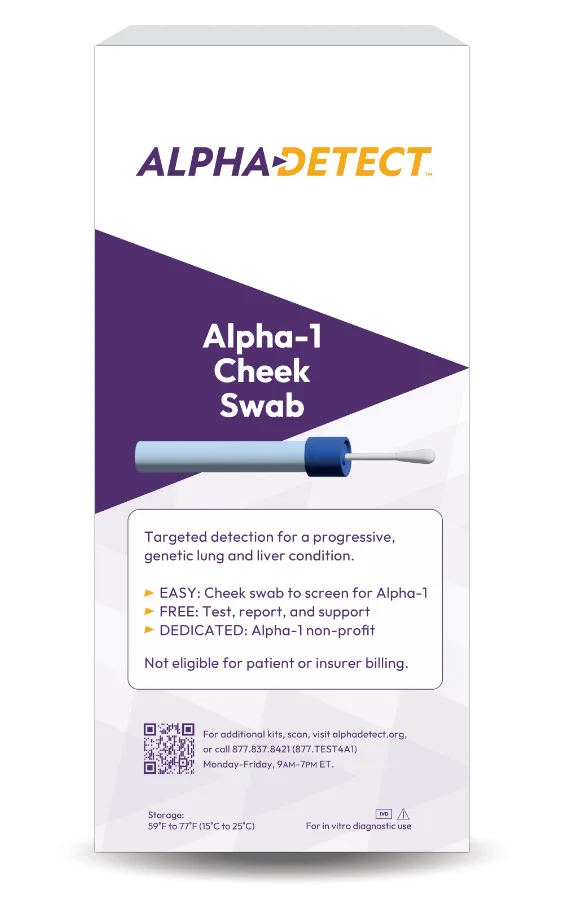
Included in the kit:
-

Cheek Swab
-
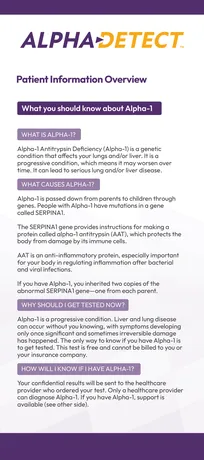
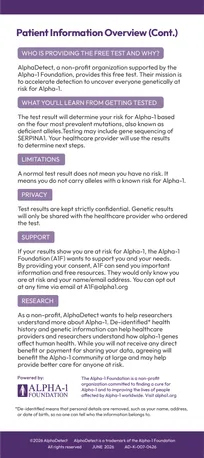
Patient Information Overview
-
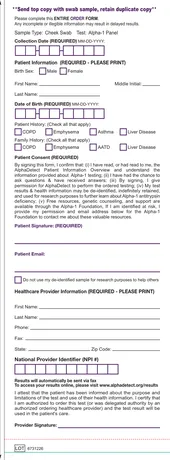
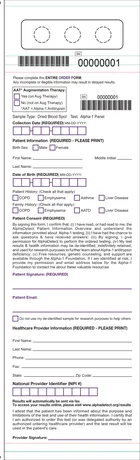
Order Form
-
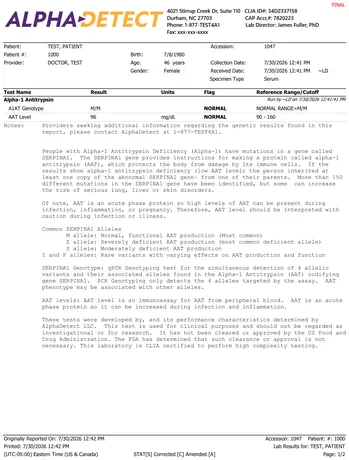
Test Report
Early detection gives patients options. Finding Alpha‑1 sooner can help improve outcomes.

Alpha‑1 is a progressive, genetic condition affecting the liver and lungs.
Because Alpha‑1 symptoms often overlap with more common diseases, affected individuals may go undiagnosed for years. In fact, a retrospective study found that the average interval between the onset of symptoms and diagnosis was 8.3 years. This underscores the importance of accelerating detection to avoid real and irreversible consequences.
Detection provides timely answers for critical decision making.
Mean Time From First Symptoms to Diagnosis

Many clinical practice guidelines, standards, and expert consensus statements recommend testing for Alpha‑1 in patients with liver and/or lung disease,,,






To ensure that no affected individual goes undetected, test your patients with:
Early detection can help guide appropriate management and prevent irreversible damage due to progressive liver and/or lung disease.
Recommendations above are from the American Thoracic Society (ATS), European Respiratory Society (ERS), the American College of Chest Physicians (CHEST), Global Initiative for Chronic Obstructive Lung Disease (GOLD), the American Gastroenterological Association (AGA), the American Association for the Study of Liver Diseases (AASLD), and the European Association for the Study of the Liver (EASL). They are representative, but not fully inclusive of all reference sources.

AlphaDetect’s Provider Engagement Team partners with healthcare providers and organizations. Together, they build sustainable, guideline-aligned Alpha‑1 detection programs and protocols. If you’re interested in implementing or expanding routine Alpha‑1 testing within your practice or health system, we’d like to hear about your goals. .

AlphaDetect provides free finger stick and cheek swab collection kits combined with Alpha‑1 genetic testing reports, and support. This makes it easy for you and your teams to test your patients with liver and/or lung disease as part of your standard of care.
Each kit provides the supplies needed, including a USPS postage-paid mailer. Additionally, you have the option to speak directly with the medical director of AlphaDetect for personalized support.
Reports are sent via eFax within 7-10 business days after the sample is received at our North Carolina lab and are also available through the AlphaDetect portal. Patient information is kept in the strictest confidence by our lab. Only the healthcare provider will have access to the report. The provider will share the results and their meaning with the patient. .
Included in the kit:
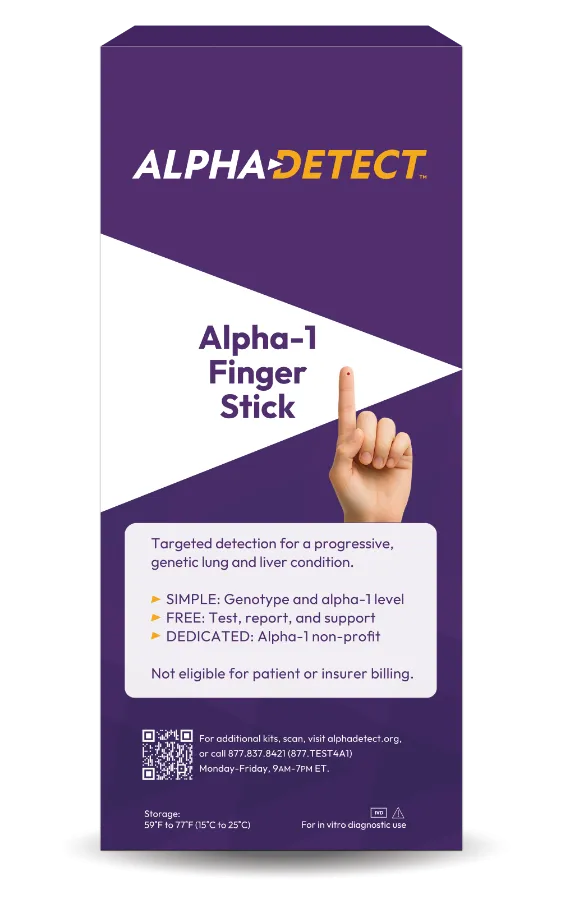
Included in the kit:


We offer educational resources, including the Detection Playbook, with proven, actionable strategies to build on your detection efforts.
For patients who are detected, AlphaDetect serves as a seamless point of entry to the Alpha‑1 Foundation’s support and materials.
Make ruling out Alpha‑1 an early and essential part of care for your patients with liver and/or lung disease, consistent with clinical practice guidelines.
Approximately 20 million in the U.S. carry at least one deficient allele associated with Alpha‑1. Finding them starts with testing.

AlphaDetect is unifying and activating the Alpha‑1 community around its mission: accelerating detection to uncover everyone genetically at risk for Alpha‑1. We appreciate the support of our inaugural industry sponsors, which is enabling us to amplify our efforts.





References: Campos MA, Wanner A, Zhang G, Sandhaus RA. Trends in the diagnosis of symptomatic patients with α1-antitrypsin deficiency between 1968 and 2003. CHEST. 2005;128(3):1179-1186. American Thoracic Society; European Respiratory Society. American Thoracic Society/European Respiratory Society statement: standards for the diagnosis and management of individuals with alpha-1 antitrypsin deficiency. Am J Respir Crit Care Med. 2003 Oct 1;168(7):818-900. doi:10.1164/rccm.168.7.818. PMID: 14522813. Sandhaus RA, Turino G, Brantly ML, et al. The Diagnosis and Management of Alpha-1 Antitrypsin Deficiency in the Adult. Chronic Obstr Pulm Dis. 2016 Jun 6;3(3):668-682. doi:10.15326/jcopdf.3.3.2015.0182. Global Initiative for Chronic Obstructive Lung Disease (GOLD). Global Strategy for Prevention, Diagnosis and Management of COPD: 2026 Report. Fontana, WI: Global Initiative for Chronic Obstructive Lung Disease; 2026. https://goldcopd.org/wp-content/uploads/2026/01/GOLD-REPORT-2026-v1.3-8Dec2025_WMV2.pdf Accessed September 4, 2026. Loomba R, Clark VC, Mandorfer M, Miravitlles M, Brantly M, Karpen SJ, Krag A, Kwo PY, Rockey DC, Russo MW, Sanchez AJ, Santarella S, Sharpton SR, Strange C, Teckman JH, Turner AM, Vargas HE, Strnad P. Multi-Society Expert Panel Consensus Guidance Regarding Clinical Assessment and Clinical Trial Endpoints in Adults With Alpha‑1 Antitrypsin Deficiency-Associated Liver Disease. Gastroenterology. 2026 Apr;170(4):829-842. doi:10.1053/j.gastro.2025.12.012. Epub 2025 Dec 11. PMID: 41390004.